
B Duncan Ltd
Fixing a Slow, Inconsistent Motor Production Tester
Production tester for mass-produced electronic devices
In brief
An existing motor production tester wasn’t providing consistent results, and took over one minute to test and configure each motor.
Results
- Test time cut from one minute to under 10 seconds
- Motor start-up 20x faster
- Plans for building new machines no longer required
Challenge
Our client had an existing motor production efficiency and torque / speed profiling tester that wasn’t providing consistent results. Some motors would fail the first test run, and then pass the subsequent tests. They attempted to calibrate without any success and so asked us to review the system.
The production tester was used for testing millions of motors and was needed to provide consistent results. The tester was also very slow, taking over one minute to test and configure each motor.
Solution
We first split up the calculations made into each measurement to allow a review of the raw data that contributed to the errors and inconsistencies. We then reviewed the custom acquisition hardware and firmware and captured more benchmarking data to highlight the source of all errors in the data.
Once all errors were identified we worked on improving the firmware to correct the data acquisition, processing filters, and synchronization methods.
During the improvements, we reviewed how much faster we could speed up the process to improve production throughput.
Firstly, we reduced the motor testing time from one minute down to less than 10 seconds and increased the number of data points that were recorded on the torque-speed line. This was found possible by reusing the existing communication interface to support new commands for a faster testing mode.
With such improvements in testing time, we moved to parallel testing and configuring the device. This significantly reduced production waiting time and increased utilization of existing testing machines.
With consistent fast data we then developed a calibration process, such that all machines in production were able to give accurate data across all test rigs.
We uncovered further issues during testing, which we were also able to remedy.
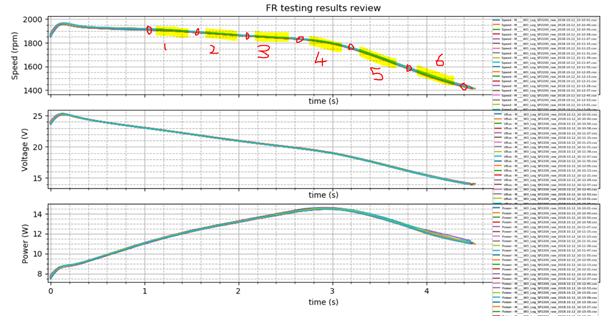
Testing results review – showing overlay of 100 motors being tested in 5 seconds with consistent results
This reduced errors significantly and improved data consistency.
This new mode was then developed into the firmware of the DUT, such that the motor was able to start up 20x faster than normal.
Previous plans for building new machines were no longer required due to the increased speed of production.
Newly improved barcodes were developed to allow easier configuration of the motors.
Overview
Using a mixture of off-the-shelf and custom hardware developed, we were able to provide our client with consistent and reliable production testing. This scenario can be replicated to resolve similar issues in your device’s production testing processes.
| Software functions |
|
|---|---|
| Hardware used |
|
Benefit to our client
Production processes are greatly improved
Fewer test rig machines are required
Reliable and consistent testing of motors
Passing criteria are much more stringent now to allow detecting subtle production issues or tolerance changes on components used
Allows automatic testing of a single motor for consistency tests
Tools developed to allow analysing all of the data for accuracy
All raw data recorded into databases to allow traceability in case of future device returns
Full traceability of hardware, firmware, calibration data, and testing software that is run
Simple barcode interface with LCD display