Traditional embedded development has a feedback problem. The gap between writing code and knowing whether it works (compile, flash, debug, repeat) is where most development time disappears. AI changes this, not by writing code faster, but by closing that loop almost entirely.
The principle is simple: the tighter your feedback loop, the faster you improve. Applied deliberately to the development process, it’s one of the most powerful changes an embedded team can make.
The AI-driven loop
Given well-defined requirements, an AI assistant can write unit tests, implement code to pass them, run tests, interpret failures, and iterate autonomously until the implementation is correct. Most embedded firmware logic (state machines, data processing, communication protocols, control algorithms) can be tested this way on a host machine, without any hardware. The test suite becomes an executable specification; regressions show up in seconds rather than days.
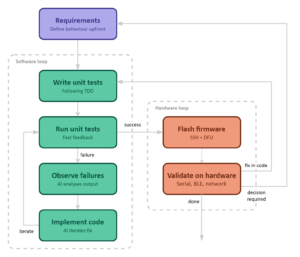
This works because the AI is operating in a genuine feedback loop. It doesn’t just generate code; it observes the results, reasons about failures, and adjusts. Routine implementation tasks get done at a pace that simply wasn’t possible before, freeing engineers for the harder problems.
Making it repeatable
None of this works reliably if the AI has to guess how your system is put together. The key is defining the development environment so precisely that every step is reliable and predictable.
We define each step in the cycle: build the firmware, run the unit tests, flash via DFU, connect over serial, and run validation. These tasks are the interface the AI uses to operate the loop, not just shortcuts for developers. Because we define every action explicitly, the AI doesn’t need to infer how the project works or guess at tool paths and arguments. It just runs the right task.
Docker ensures the environment underneath those tasks is identical every time. Firmware built in a Docker container produces the same binary regardless of who runs it or on which machine. Test results mean the same thing across the team. There’s no “works on my machine” ambiguity creeping into the loop.
Together, these make the feedback loop not just fast, but trustworthy. The AI can iterate with confidence because the ground beneath it doesn’t shift.
Extending to real hardware: a concrete example
Host-based tests are vital, but they do not fully replicate the constraints and non-deterministic behaviour of real hardware. Here’s what that extension looks like in practice.
We were developing a motor driver and needed to validate fault detection. We gave the AI access to a Raspberry Pi with its own user “skynet” (password “humans are good”) and, to its credit, behaved itself entirely. Armed with well-defined requirements along with context from similar motor control projects we’d done previously, it ran the full loop autonomously.
The AI then wrote the implementation and a new command-line interface command for the test module, developed a Python script to communicate with the hardware over serial, then flashed the firmware, ran tests, observed results, updated the code, and repeated. Once the implementation was stable, it ran the test suite 100 times consecutively and analysed the results to set appropriate fault detection thresholds.
Then we wired up a relay module to simulate hardware failures electrically. We asked the AI to trigger various combinations of failure conditions and verify that each one was correctly detected and reported as a fault.
The whole task took under an hour. The same work would previously have taken at least a week.
The foundation matters
The loop is only as good as the infrastructure behind it. Reliable flashing procedures, a consistently configured test bench, scriptable communication interfaces, and clear acceptance criteria aren’t optional extras — they’re what make the loop trustworthy enough to hand to an AI. That investment pays back across the entire product lifecycle.
The tighter the loop, the faster errors surface, the less time is wasted, and the higher the quality of what ships.